
First past the post
In our first attempt we sowed four things at once. Radish won easily: it was ready on day six, two days ahead of the broccoli and the mustard. We were so pleased we forgot to weigh the harvest.
What we cut isn't the little red ball you know from the market. That's the root, and it needs a few weeks to swell. Here we stop at the very beginning: a thin stem, sometimes pink, and two heart-shaped leaves. Everything above the growing medium gets eaten.
Daikon, the long white radish of Japanese cooking, is the same species as red radish. In Japan, baby daikon plants are sold in little boxes at the supermarket and have a name of their own: kaiware.
It's no newcomer to the kitchen, either. By the 1st century, Greek and Roman writers were already describing mild and sharp radishes, small and large.
The heat comes later
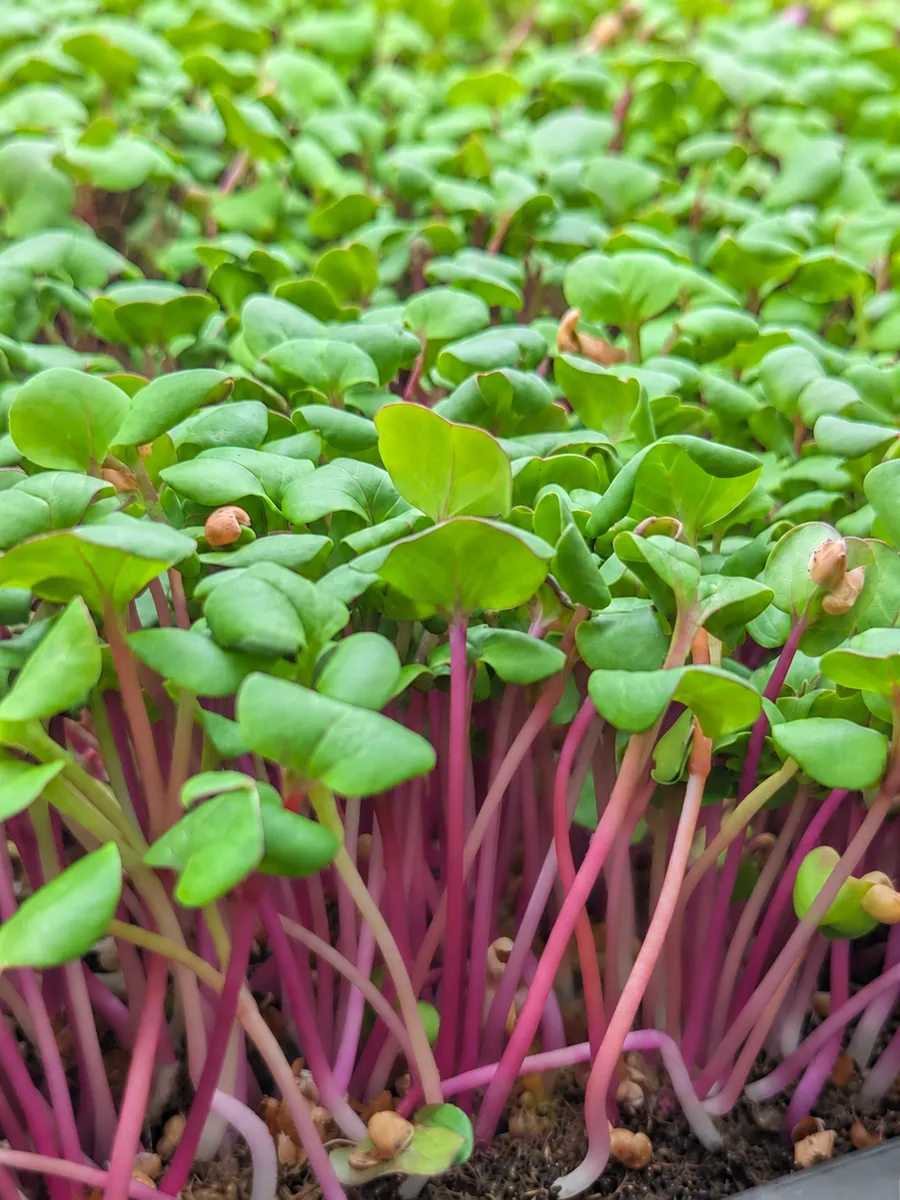
You bite, and at first it's all freshness: a juicy stem that snaps, tender leaves, a clean green taste. The heat arrives at the end, just as you're about to swallow, peppery like raw radish.
That's probably no accident. The heat comes from isothiocyanates, the same family of compounds that bites in mustard and wasabi, and they only form when the plant is crushed between your teeth: first you chew, then it bites. Heat stops them forming. If you read our micro broccoli post, you already know how it works. Here, what it gives you is mostly flavour.
That order is what makes it useful. A dish gets freshness on the first forkful and a nudge at the end. It does pepper's job, with juice.
Green or purple
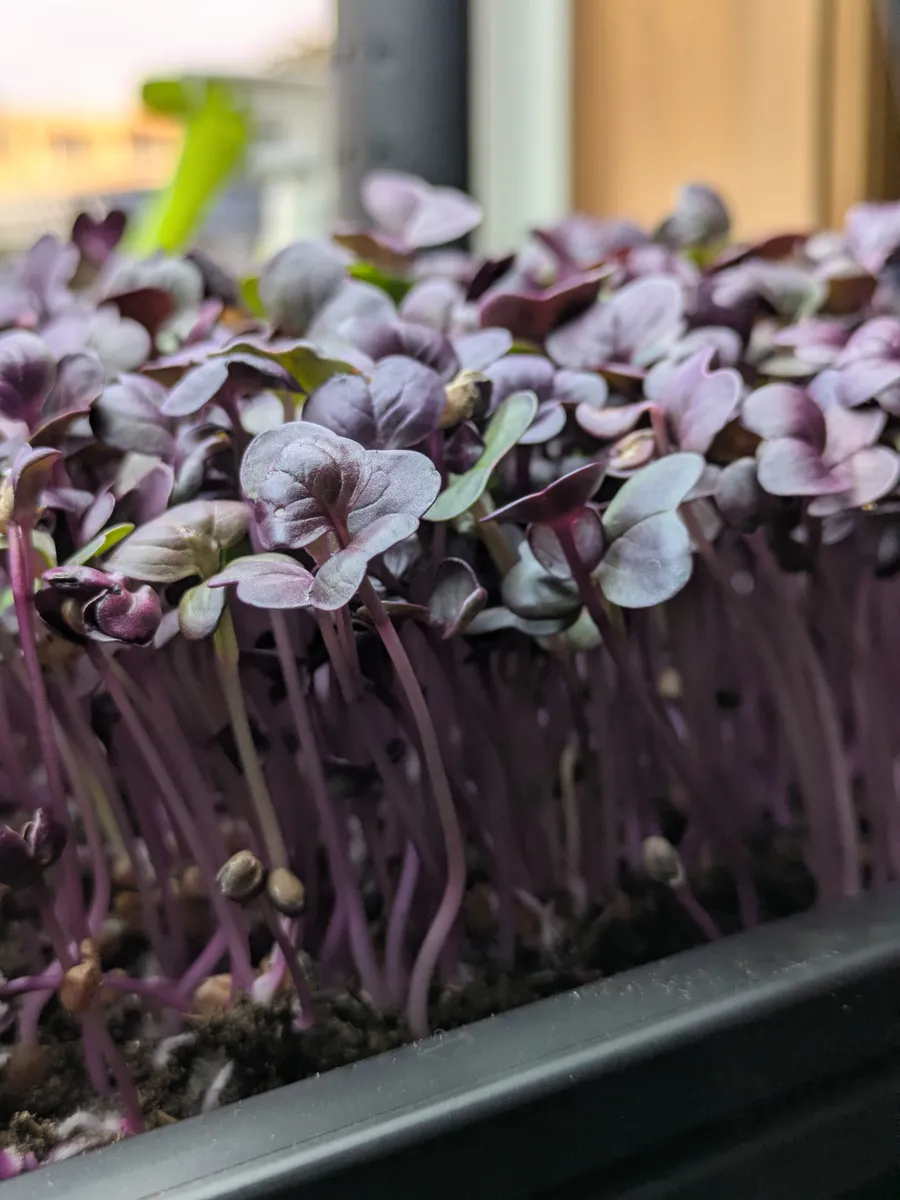
Radish microgreens aren't all alike. Some varieties have white or pink stems and green leaves; others are purple from the base of the stem to the leaf tips. In taste, they're close relatives. On the plate, they're not.
| Green | Purple | |
|---|---|---|
| Looks | White or pink stem, bright green leaf | Purple from stem to leaf |
| Taste | Hot and fresh | Hot and fresh |
| Shines on | Colourful dishes, where green makes a contrast | Pale dishes: rice, fish, cheese, eggs |
| Pigment | Chlorophyll | Anthocyanins |
The purple is the same as in red cabbage and blueberries, and the plant only makes it in the light. For the first few days, spent in the dark, the stems are pale; the colour comes later.
Kitchen trick: anthocyanins react to acidity. Add a drop of lemon or vinegar and the purple turns pink.
Where the heat helps
Radish microgreens like dishes that need waking up.
With fat, they cut through. On a steak, a tartare or a board of sharp cheeses, they clear the palate between bites.
With broths, they brighten. A handful on top of ramen, once it's in the bowl, next to the egg, and the first sip changes.
With soft things, they add bite. Tacos with lime, avocado toast, poke and sushi, the way the Japanese use kaiware.
They always go on last, off the heat. Cooked, they lose their bite, their crunch and some of their colour.
Are they good for you?
They have vitamin C and glucosinolates, and the purple ones have anthocyanins too. In a US Department of Agriculture study comparing 25 microgreens, a daikon radish had the most vitamin E of all.
But let's keep our feet on the ground: you use them by the handful, as a seasoning. The best thing they bring to a dish is flavour and colour.
Common questions
There's white fuzz at the base. Is it mould?
Almost certainly not. Radish grows lots of fine, white root hairs that look like cotton wool. If they vanish when you mist them with water, they're roots. Mould doesn't go away and usually smells bad.
Are they very hot?
They bite, but only at the end, after a fresh first bite. If you like raw radish, you'll feel at home.
How do I store them?
In the fridge, dry, in a closed box. Only wash them right before using.
Where can I get radish microgreens in Porto?
At VerdeNova: we grow them and deliver in Porto. Order in the shop.
Stay with us and watch VerdeNova grow, seed by seed.